AI.txt vs LLMs.txt: Understanding the Difference
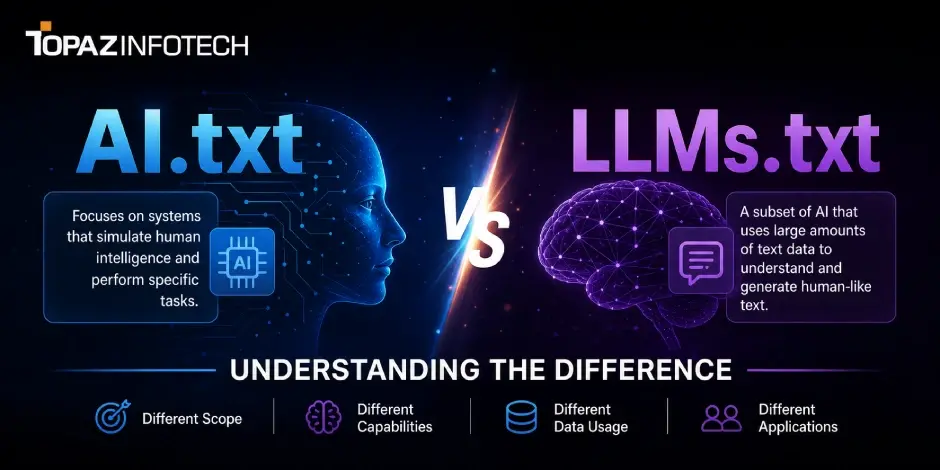
AI.txt and LLMs.txt sound like cousins, but they solve different problems. One is about permission and policy, while the other is about helping AI systems find, read, and interpret your best content more cleanly.
For site owners, marketers, and SEO teams, that difference matters because it changes how you think about content visibility, AI search, and answer engine optimization, or AEO.
What AI.txt Does
AI.txt is best understood as a statement of intent. It is meant to tell AI systems what they may or may not do with your content, especially around training, commercial use, attribution, and real-time access.
That makes AI.txt feel closer to a right notice than a content guide. In the examples currently discussed in the industry, it can include permission flags such as whether training is allowed, whether attribution is required, and who to contact if a company wants to negotiate usage terms.
The big idea is simple: AI.txt is about control. If a publisher wants to set boundaries for how its content is used by AI tools, AI.txt is the file that speaks that language.
What LLMs.txt Does
LLMs.txt takes a different approach. Instead of focusing on consent, it helps large language models understand which pages matter most and how a site is organized, usually through a plain Markdown file at the site root.
That structure matters because AI crawlers and assistants often do better with curated summaries, clean links, and simple headings than with a full HTML page loaded with navigation, scripts, and clutter. In practice, LLMs.txt works like a compact guidebook for AI systems that need fast context on a site.
This is why people working on GEO, or generative engine optimization, pay attention to it. A well-written LLMs.txt can help AI tools find the right pages faster and understand what the site is trying to say before they quote it or summarize it.
The Core Difference
The easiest way to think about AI.txt vs LLMs.txt is this: AI.txt asks, “What may AI do with this content?” while LLMs.txt asks, “What should AI read first?”.
That one distinction separates policy from discovery. AI.txt is about consent and usage limits, while LLMs.txt is about structure, prioritization, and content clarity.
Why This Matters
For brands publishing original content, the distinction affects both legal posture and discoverability. AI.txt can signal a preference around training or reuse, while LLMs.txt can improve how AI systems surface your content in answer-based search experiences.
That is where AEO comes in. If your pages are easier for AI to parse, a model has a better chance of picking the right source, quoting the right section, and describing your business accurately.
AI.txt in Practice
AI.txt is still an emerging idea, so expectations need to stay realistic. Current discussions describe it as a newer proposal with limited adoption, and the major challenge is enforcement because an unpublished standard only helps if AI providers actually read it.
Still, the appeal is easy to understand. A publisher that wants to set clear terms for training, attribution, or commercial reuse can put those terms in a single place instead of hoping every platform interprets a policy page correctly.
For legal, editorial, and brand teams, that kind of clarity can be useful even before any broad adoption arrives. It gives the business a standard way to express its rules for AI interaction.
LLMs.txt in Practice
LLMs.txt is more immediately practical for content teams. It is usually written in Markdown, and it points AI systems toward the pages that matter most, often with short descriptions that make the purpose of each page obvious.
That can help with doc’s sites, product pages, knowledge bases, and company blogs where AI search is already sending traffic. If a model can quickly see your best explanations, service pages, and guides, it is less likely to guess wrong or pull from weaker pages.
This is also why LLMs.txt fits GEO work so well. GEO depends on making content easier for generative systems to discover, read, and trust, and a clean content map supports that goal better than a policy-only file ever could.
How They Work Together
These two files are not competitors. A site could use AI.txt to define usage preferences and LLMs.txt to guide discovery, which gives publishers both policy language and content direction.
That pairing makes sense for companies that publish a lot of original material and care about both rights and visibility. One file says how the content should be handled, while the other helps AI systems interpret what the content is for.
What to Prioritize
If the goal is better AI search visibility, LLMs.txt is usually the first file worth thinking about. It is the one tied to content structure, discoverability, and readable summaries, which are the ingredients that matter most for AI-facing search use cases.
If the goal is policy control, AI.txt is the more relevant concept. It is the file that speaks to permissions, attribution, and whether content can be used in training or commercial contexts.
For most teams, the practical order is obvious. Start by making the site easier for AI to understand, then decide whether a permission layer is also needed.
SEO, AEO, and GEO
Traditional SEO still matters, but it is no longer the only game in town. AEO asks how your content gets selected and quoted in answer engines, while GEO focuses on how generative systems retrieve and present your information.
LLMs.txt fits naturally into both because it organizes the material AI systems should read first. AI.txt fits a different need because it defines terms of use rather than improving retrieval.
That difference can shape content strategy. If a brand only cares about visibility, LLMs.txt is the more directly useful tool; if the brand also worries about content reuse, AI.txt adds a policy layer.
Common Misunderstandings
One common mistake is assuming the two files do the same job because both sound AI-related. They do not.
Another mistake is treating LLMs.txt like robots.txt. Robots.txt controls crawl access, while LLMs.txt is more like a curated guide for AI understanding. That means it helps with interpretation, not hard blocking.
A third mistake is thinking either file guarantees results. Adoption is still uneven, and AI systems do not all behave the same way, so both files should be part of a broader content and policy strategy rather than a magic fix.